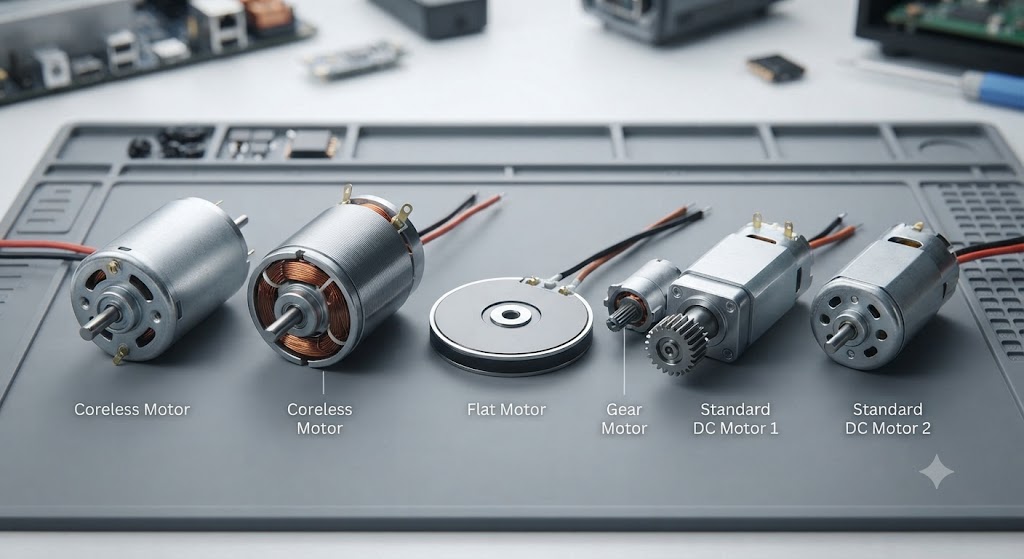
Electric motors are widely used across all industrial and commercial sectors, accounting for a massive share of total global electricity consumption—with motor systems consuming over 60% of China’s total societal electricity. Optimizing motor energy efficiency is no longer just an operational choice; it is a critical strategy for global sustainability, carbon reduction, and cost savings.
The Current Landscape of Motor Applications
To meet diverse mechanical transmission and power requirements, China’s industrial sector has developed an extensive lineup of small and medium-sized electric motors across hundreds of series and thousands of specifications.
- Market Dominance: According to data from the Electrical Industry Association’s Motor Branch, small and medium-sized AC motors comprise 92.7% of the total market capacity, with small motors alone making up 71.5%.
- Common Series: Core components of the domestic market include traditional lineups such as the Y series, Y2 series, and the more advanced YX and YX2 series.
- The Efficiency Gap: While China possesses the technical capacity to manufacture high-efficiency motors (such as YX, YX2, and Y2E series), domestic market adoption has historically lagged. In the early 2000s, the vast majority of high-efficiency production was exported to meet standards like the US NEMA specifications, leaving domestic deployment below 7%.
The Massive Energy-Saving Potential
Motors convert electrical energy into mechanical energy, consuming roughly half of all generated electricity.
- The Impact of a 2% Efficiency Gain: If total motor efficiency across a national grid improves by just 2%, it can save tens of billions of kilowatt-hours of electricity annually—equivalent to the annual output of multiple large-scale power stations.
- Dual Benefits: This reduction directly translates to lower primary energy consumption, decreased carbon dioxide emissions, deferred power infrastructure investments, and massive long-term electricity bill savings for industrial operators.
What Defines a High-Efficiency Motor?
High-efficiency motors—typically high-efficiency three-phase asynchronous motors—meet or exceed national energy-saving evaluation standards. Compared to standard legacy models:
- Reduced Losses: Total energy losses are reduced by 20% to 30%.
- Efficiency Boost: Operating efficiency increases by 2% to 6% depending on regional standards (such as NEMA guidelines in the United States or national standards in China). Ultra-high-efficiency variants push boundaries even further.
- Optimized Efficiency Curves: Unlike conventional motors whose efficiency drops sharply under partial loads, high-efficiency motors maintain a relatively flat efficiency curve across varying operational workloads.
To maximize facility energy conservation, industrial designs must ensure that motor input energy closely matches mechanical load requirements under continuous or frequent-start operating conditions, minimizing internal electromagnetic and mechanical losses.
📌 We accept customized specification/parameters/drawings, contact us now for your requirement. Our engineering team will be delighted to make samples for you.
-
📧 Email Us: chinaok321@gmail.com
-
📱 WeChat/Mob: +8613713792667 ( our Whatsapp is blocked, please don't use whatsapp, just email, thanks)