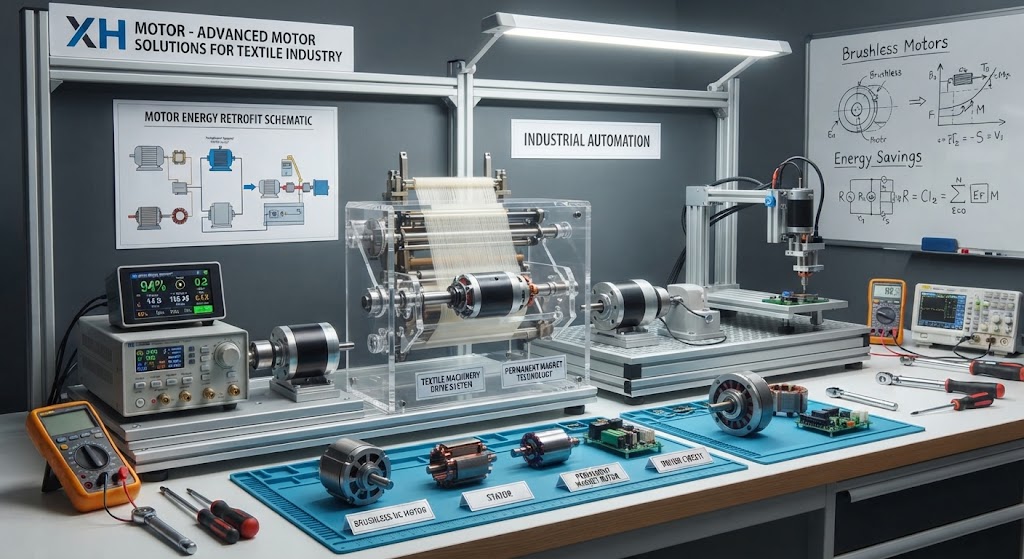
As traditional manufacturing accelerates its transition toward intelligence and sustainability, the textile industry faces multi-faceted challenges: boosting production efficiency, reducing energy consumption, and strictly controlling maintenance costs. As the core power source of textile machinery, motor performance directly dictates overall operational efficiency. In recent years, brushless motors (including brushless DC motors and advanced drive tech)—valued for their high efficiency, low noise, long service life, and exceptional precision control—have rapidly emerged as a critical core technology for modernizing textile equipment.
As a brand dedicated to advanced motor solutions, XH Motor explores the application scenarios, technical classifications, and future value of brushless motors in the textile industry.
I. Why Does the Textile Industry Need Brushless Motors?
Textile production environments are notoriously harsh, often involving high temperatures, elevated humidity, flying lint, and continuous, round-the-clock operations. Traditional brushed motors rely on mechanical commutators (carbon brushes), which are prone to wear, dust accumulation, and spark risks under these conditions, alongside heavy energy losses.
The working principle of a brushless motor relies on electronic commutation, using an integrated or external controller to precisely regulate current direction and magnitude:
- High Efficiency & Energy Saving: Eliminates mechanical friction and energy losses, significantly boosting electrical conversion rates.
- Low Noise & High Stability: Optimized operational smoothness effectively improves the working environment on the factory floor.
- Low Maintenance Costs: The brush-free wear design extends overall equipment lifespan, massively reducing economic losses caused by unexpected downtime.
II. Major Motor Classifications and Applications in the Textile Industry
Textile machinery varies widely, with different production processes placing unique demands on speed precision, tension control, and dynamic response:
1. The Workhorse: Three-Phase Asynchronous Motors
The most fundamental and widespread power source in textile plants, handling conventional driving tasks:
- General-Purpose Asynchronous Motors: Ideal for simple drives or auxiliary equipment where speed regulation precision isn’t critical.
- Textile-Specific High-Efficiency Motors: Specifically engineered for the hot, humid, and lint-heavy textile environment, featuring outstanding fiber-clogging resistance and high overload capacity. Newer standards push these motors to high energy-efficiency levels like IE4, driving large-scale facility energy savings.
2. Precision & Energy Saving: Permanent Magnet Synchronous Motors (PMSM)
Increasingly deployed in operations requiring strict energy savings and precise control:
- Spinning Frame Energy-Saving Retrofits: Replacing traditional asynchronous motors with direct-drive permanent magnet synchronous motors on spinning frames (core yarn-production equipment) is a clear industry trend. Tests show that power consumption per kilogram of yarn drops by roughly 9%, with significantly lower motor heat generation.
- Standardized Applications: National standards like the FTY series for textile three-phase permanent magnet synchronous motors underline their strategic industrial importance.
3. Flexibility & Intelligence: Servo / Variable Frequency Drive Motors
Essential when equipment requires exact speed and tension control alongside complex motion profiles:
- Variable Frequency Motors: Adjust rotational speeds in real-time via inverters based on process needs. Simple open-loop control suits knitting machines, while closed-loop vector control (akin to AC servo) powers sectional warpers and sizing machines requiring constant tension and line speed.
- Servo Motors: Delivers precise drive and high-speed response for components like the “dobby shedding motion” on looms (controlling heald frame movement to form the shed).
4. Special Forces: Switched Reluctance Motors & Brushless DC Motors
Tailored, professional solutions for specialized mechanical systems:
- Switched Reluctance Motors: An emerging choice for modern rapier looms (a mainstream shuttleless loom type). They offer massive starting torque (up to 5x rated torque), support direct drive to eliminate clutches, streamline system structures, enable precise “pick-finding” to eliminate stop marks, and support high-speed weaving at over 650 RPM.
- Brushless DC Motors: Widely used in air-jet spinning machines to drive their core component—the ultra-high-speed spinning rotor—perfectly matching the system’s demands for high efficiency, rapid dynamic response, and superior stability.
III. Conclusion and Outlook
From primary roving and spinning to high-speed weaving and dyeing, brushless motors and high-performance specialized electric motors are comprehensively empowering the automation and decarbonization of the textile sector. By integrating advanced motor control solutions, textile enterprises can slash unit consumption, elevate product quality, and significantly sharpen market competitiveness.
To learn more about high-efficiency motor technologies and customized solutions, please visit www.coreless-motor.com
Related Tags: #BrushlessMotor #TextileMachinery #PermanentMagnetMotor #HighEfficiencyMotor #XHMotor #IndustrialAutomation #MotorEnergyRetrofit
📌 We accept customized specification/parameters/drawings, contact us now for your requirement. Our engineering team will be delighted to make samples for you.
-
📧 Email Us: chinaok321@gmail.com
-
📱 WeChat/Mob: +8613713792667 ( our Whatsapp is blocked, please don't use whatsapp, just email, thanks)