As smart devices continue to shrink—from agile bionic robotic fingers to intricate medical surgical instruments—traditional motors often fall short due to bulky dimensions and sluggish response times. The emergence of the micro coreless motor directly addresses this core conflict, utilizing a revolutionary “ironless” structure to deliver high-efficiency, precision power output within an ultra-compact footprint.
What It Is: The Breakthrough “Ironless” Design
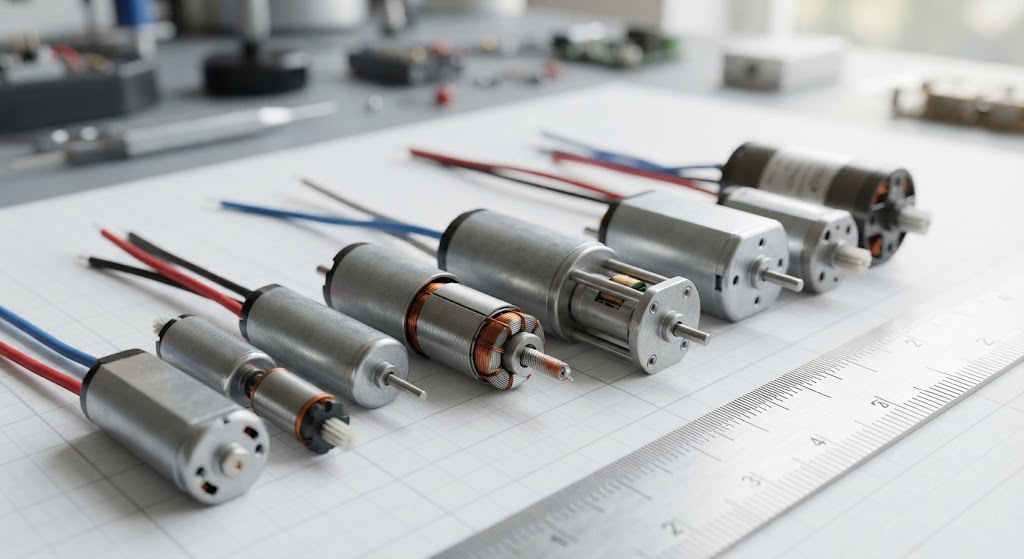
To understand the coreless motor, one must look at its unique architecture. The rotor of a traditional DC motor consists of an iron core made of stacked silicon steel sheets, with coils wound around it. In contrast, the micro coreless motor completely eliminates this iron core. Its rotor is a thin-walled, hollow cup structure formed by self-supporting coils, resembling a small drinking cup. This fundamental transformation completely eliminates eddy current losses (iron losses) caused by the iron core while drastically reducing rotor weight and moment of inertia.
Depending on the commutation method, micro coreless motors are divided into two main categories:
- Brushed Micro Coreless Motors: The coils rotate as the rotor, with a mechanical commutator and brushes working together to complete physical commutation.
- Brushless Micro Coreless Motors: The coils remain stationary, while permanent magnets act as the rotating rotor, utilizing electronic control to handle commutation.
Core Advantages: Fast, Stable, and Efficient
- Rapid Response and Precise Control: Because the rotor lacks an iron core, its moment of inertia is significantly reduced, allowing the micro coreless motor to achieve millisecond-level startup and stopping. Combined with a slotless rotor structure, it operates without the “cogging” feel of traditional motors, resulting in minimal torque ripple and exceptionally smooth, linear speed control.
- High Energy Efficiency: Eliminating iron losses substantially boosts the motor’s energy conversion efficiency. Given the same battery capacity, devices powered by micro coreless motors generally enjoy extended operating runtimes.
- High Power Density: Despite their tiny dimensions, micro coreless motors deliver impressive power output within confined spaces. The combination of a compact commutation system and powerful rare-earth magnets yields a power density far exceeding conventional motors of the same size.
Technical Tip: Micro coreless motors are not entirely without limitations. Because the thickness of the rotor coil is constrained by magnetic circuit design, their maximum power output is typically limited. Additionally, some brushed models lack varistor protection, presenting certain limitations regarding brush lifespan and electrical noise control.
Application Scenarios: From Fingertips to Aerospace
The application scope of micro coreless motors covers nearly every scenario demanding “minute, precise power”:
- Medical and Healthcare: Surgical robots rely on them for precise manipulation within confined spaces; orthopedic surgical tools depend on them for stable drilling power; and ventilators and drug infusion pumps use them to accurately control flow rates and pressures. In prosthetics, the lightweight and rapid-response attributes of micro coreless motors provide users with a more natural and fluid operational experience.
- Humanoid Robotics and Automation: Humanoid robot dexterous hands require embedded power sources within every finger joint; micro coreless motors measuring 10mm or smaller, paired with micro gearboxes, serve as the crucial driving components for complex hand movements.
- Consumer Electronics and Drones: Micro drones utilize models like 8520 and 615 micro coreless motors to drive propellers, striking an ideal balance between lightweight design and high rotational speeds. They are also widely found in everyday items such as electronic toys, mobile phone vibration modules, and electric toothbrushes.
Technical Specifications Overview
Current market offerings for micro coreless motors form a comprehensive product lineup. Diameters can be as small as 4mm with a length of only 8mm, while standard specifications span frame sizes from 6mm to 22mm. No-load speeds range anywhere from several thousand RPM up to 48,000 RPM, with select models reaching 32,250 RPM under 4.5V drive conditions.
Typical product benchmarks include:
- A 6mm-diameter micro coreless motor operating at a rated voltage of 3V, delivering a rated speed of 11,000 RPM with a rated current of just 70mA and a stall current of 110mA.
- High-performance variants capable of achieving a rated speed of 26,500 RPM at 3.2V with a rated load of 2.5 g·cm.
Visit www.coreless-motor.com to explore additional micro coreless motor specifications, parameters, and customized engineering solutions.
📌 We accept customized specification/parameters/drawings, contact us now for your requirement. Our engineering team will be delighted to make samples for you.
-
📧 Email Us: chinaok321@gmail.com
-
📱 WeChat/Mob: +8613713792667 ( our Whatsapp is blocked, please don't use whatsapp, just email, thanks)