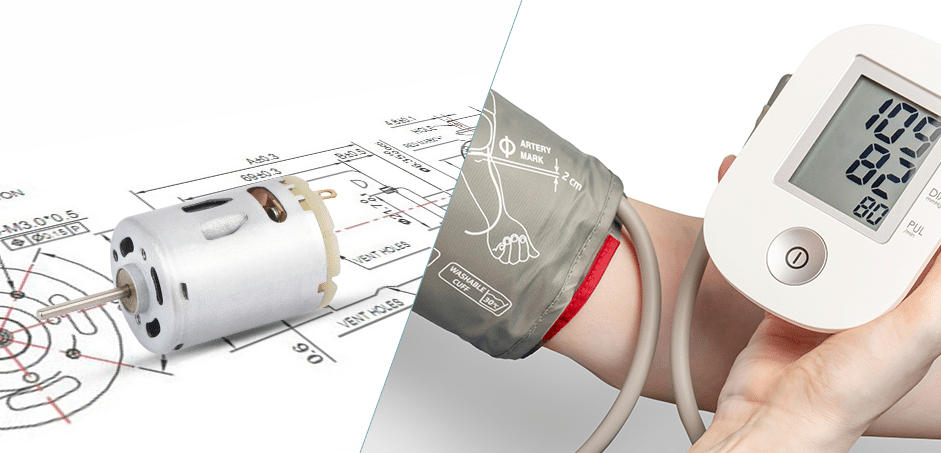
In today’s medical device market, driven by trends toward miniaturization and portability, electronic sphygmomanometers are rapidly gaining popularity in home and mobile healthcare settings. As a core tool for tracking cardiovascular health using the oscillometric method, the measurement accuracy and user experience of an electronic sphygmomanometer rely heavily on the stable output of its internal pump system.
However, many design engineers face common pain points during product selection: slow inflation speeds, high operational noise, and limited internal space. These issues often stem from a poor match with the pump’s driving core—the motor. Speed fluctuations or vibration interference can negatively impact pressure sensor signal acquisition and diminish the overall product quality.
Core Architecture of Electronic Sphygmomanometers and the Role of Motor Driving
An efficient electronic sphygmomanometer typically operates through the coordination of the following key components:
- Pump System: Driven by a motor, it is responsible for rapidly inflating the cuff. The motor’s starting torque and load stability directly determine pressurization efficiency.
- Solenoid Valve: Accurately controls the deflation rate, allowing pressure to drop smoothly to capture pulse wave signals.
- Pressure Sensor: Real-time monitoring of internal cuff pressure with electrical signal output.
- Human-Machine Interaction Module: Includes LCD/LED screens and optional voice prompts or data storage features.
Among these, the motor serves as the “power heart” of the entire pump system, with its performance directly determining the device’s response speed and noise performance.
Four Key Selection Criteria for High-Performance Sphygmomanometer Motors
1. Dynamic Response and Output Stability
The inflation phase requires the motor to quickly enter working state upon power-on. High starting torque and excellent continuous load stability ensure no speed lag or sluggish inflation during pressure buildup.
2. Low Noise and Vibration Control
Because home electronic sphygmomanometers have strict quiet-operation requirements, the motor’s commutation smoothness, rotational stability, and structural matching with the pump are critical for preventing resonance and irregular noises.
3. Miniaturization and High Space Utilization
Compact, integrated design schemes significantly reduce device size while delivering robust power, meeting the exterior demands of portable medical devices.
4. Recommended Hardware Solution: XH Motor RS-380H
Tailored for medical miniature pumps, the Coreless DC Motor Manufacturer recommends the RS-380H DC Motor designed specifically for electronic sphygmomanometers:
- Exceptional Speed Performance: No-load speed of approximately 13,300 rpm and rated speed around 9,850 rpm, instantly delivering ample power to the miniature pump.
- Strong Stall Torque: A stall torque reaching up to 745 g·cm, maintaining robust driving capability even under complex air circuit resistance or high cuff fitment.
Empowering Medical Innovation: Customized Driving Support
As a professional manufacturer in the DC motor field, we are dedicated to providing global medical clients with high-quality, customizable driving solutions. From preliminary motor selection and matching to subsequent structural and noise optimization, we comprehensively assist partners in breaking through performance bottlenecks to create more precise, quieter, and more portable high-end electronic sphygmomanometers.
📌 We accept customized specification/parameters/drawings, contact us now for your requirement. Our engineering team will be delighted to make samples for you.
-
📧 Email Us: chinaok321@gmail.com
-
📱 WeChat/Mob: +8613713792667 ( our Whatsapp is blocked, please don't use whatsapp, just email, thanks)